Forehead Vein Pulsations Explained
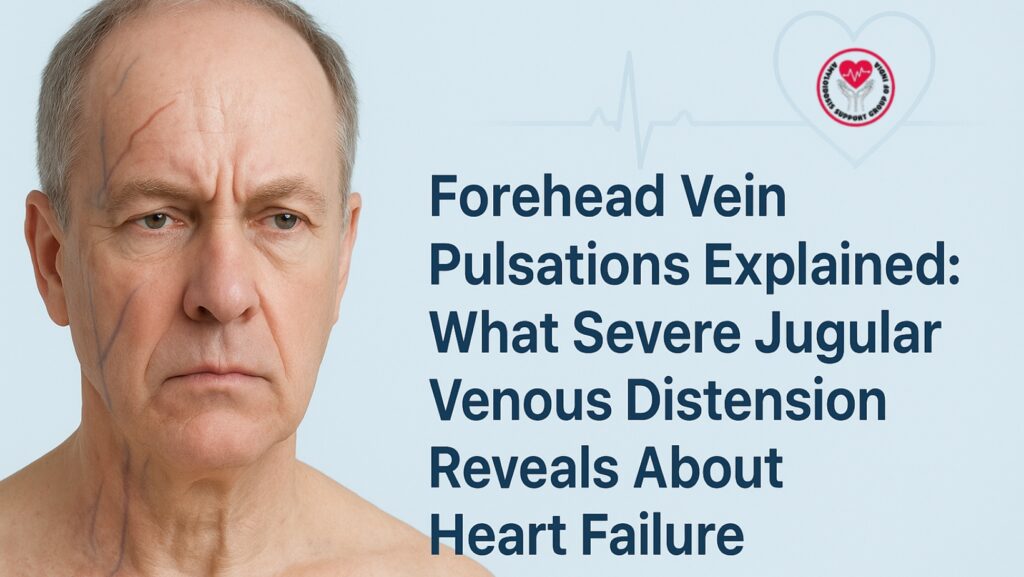
Table of Contents
Introduction
When we think of heart failure, we often picture symptoms like shortness of breath, swollen legs, or fatigue. However, in advanced cases such as cardiac amyloidosis, the body can show more unusual signs. One such sign is visible vein pulsations in the forehead. This rare indicator points to severe heart dysfunction, particularly right-sided heart failure.
Though uncommon, medical literature has documented this phenomenon. Reports, including studies in the New England Journal of Medicine (NEJM), describe instances where retrograde venous pulsations reached the forehead veins of patients with tricuspid regurgitation secondary to cardiac amyloidosis.
This article explores the science behind jugular venous distension (JVD), its extension to the forehead, and the diagnostic significance of these extreme signs.
Understanding Jugular Venous Distension (JVD)
Jugular venous distension means visible bulging in the jugular veins — large veins in the neck that carry deoxygenated blood back to the heart.
Normally, these veins are not easily seen when a person is seated or upright. However, when the right side of the heart struggles to receive or pump blood, pressure builds up in the venous system, causing the jugular veins to swell and pulsate.
Mechanism of JVD
- Increased Right Atrial Pressure
The right atrium collects blood from the superior and inferior vena cava. When the right atrial pressure rises, as seen in conditions like tricuspid regurgitation, pulmonary hypertension, or cardiac amyloidosis, the veins draining into it become enlarged. - Back Pressure in the Venous System
The increased pressure moves backward through the venous system, especially the internal and external jugular veins, causing visible swelling along the neck. - Visible Pulsations
In severe cases, these veins pulsate with each heartbeat, reflecting the backward flow of blood from the right ventricle into the right atrium.
Cardiac Amyloidosis and Its Role in JVD
AL (Light Chain) Amyloidosis occurs when abnormal plasma cells produce misfolded light-chain proteins. These proteins accumulate in tissues, including the heart, resulting in cardiac amyloidosis.
When amyloid deposits infiltrate the myocardium (heart muscle), they cause it to become stiff and thickened — characteristic of restrictive cardiomyopathy. This stiffness limits the heart’s ability to fill during diastole (the relaxation phase), leading to higher pressures in the heart chambers.
How Amyloidosis Causes JVD
- The rigid heart struggles to accept incoming blood.
- This causes a backup of blood in the right atrium and the veins draining into it.
- Over time, this congestion becomes visible as jugular venous distension in the neck.
In severe cases, especially when tricuspid regurgitation develops, the venous congestion can extend up into the facial veins, even reaching the forehead.
The Connection Between Tricuspid Regurgitation and Forehead Vein Pulsations
Tricuspid regurgitation (TR) happens when the tricuspid valve, located between the right atrium and right ventricle, does not close properly. Each time the right ventricle contracts, some blood leaks backward into the right atrium.
In cardiac amyloidosis, this leakage occurs because amyloid deposits affect the valve or the surrounding heart tissue, interfering with normal movement.
Pathophysiology of Forehead Vein Pulsations
In severe cases of TR, the backward flow of blood is so strong that:
- The right atrial pressure rises significantly.
- The pulsation travels through the internal jugular veins up to the facial and scalp veins.
- The forehead veins — typically small and inconspicuous — become visibly distended and pulsatile.
This striking clinical sign points to advanced right heart failure and indicates serious venous congestion throughout the upper body.
Clinical Case Reference: The NEJM Example
A notable case published in the New England Journal of Medicine described an 89-year-old woman with severe tricuspid regurgitation secondary to cardiac amyloidosis.
Doctors noted rhythmic pulsations in her forehead veins. These pulsations matched her heartbeat, confirming retrograde venous pressure transmission through the jugular and facial venous systems.
This finding demonstrated how advanced right heart dysfunction can show up visibly on the face, providing a crucial diagnostic clue for doctors.
Right Heart Failure: The Root of Venous Congestion
The right side of the heart pumps blood into the lungs. When amyloid infiltration affects the right ventricle or tricuspid valve, the ventricle has trouble pumping effectively.
Key Consequences
- Systemic Venous Congestion: Blood backs up in the venous system, increasing pressure in the jugular, hepatic, and peripheral veins.
- Peripheral Edema: Fluid accumulates in tissues, causing swelling in the legs and abdomen.
- Jugular Venous Distension: The neck veins bulge, and in severe cases, forehead veins pulsate visibly.
Recognizing the Signs of Severe Venous Pressure
Examining neck and facial veins can be an important diagnostic practice.
Common Signs of Severe JVD
- Visible Neck Veins even when the patient is sitting upright.
- Pulsatile Movement in the veins with the heartbeat.
- Hepatojugular Reflux: Pressing the liver causes increased jugular vein distension, indicating right heart failure.
- Facial and Forehead Vein Engorgement — seen in rare, advanced cases.
Diagnostic Value of JVD and Forehead Pulsations
These physical signs provide important insights into hemodynamic status and disease severity.
1. Estimating Right Atrial Pressure
Doctors use the height of the jugular veins to estimate right atrial pressure — each centimeter of distension above the sternal angle roughly corresponds to a 1 cmH₂O rise in pressure.
2. Distinguishing Between Cardiac and Pulmonary Causes
If JVD is prominent without lung congestion, it indicates right heart dysfunction instead of left-sided failure.
3. Identifying Tricuspid Regurgitation
Visible pulsations (rather than static distension) suggest TR, where blood flows backward with each contraction.
Why the Forehead Pulses: The Science Behind It
Typically, venous flow is one-way — from the head and neck to the heart. However, in extreme tricuspid regurgitation, the reverse pressure wave moves upward, distending superficial veins linked through the facial venous network.
Step-by-Step Mechanism
- Tricuspid valve leakage leads to backward flow into the right atrium.
- Surge in right atrial pressure transmits to the internal jugular vein.
- The internal jugular vein connects to the facial vein, which links to the superior ophthalmic and frontal veins.
- Result: Visible pulsation on the forehead due to transmitted pressure waves.
This network clarifies how venous congestion from the heart can cause pulsations far from the chest — even in the face and scalp.
Imaging and Diagnostic Tests
While visual exams offer important clues, imaging helps confirm the underlying cause.
1. Echocardiography (ECHO)
- Detects amyloid infiltration in the myocardium.
- Evaluates tricuspid regurgitation and right atrial pressure.
- Reveals restrictive filling patterns typical of cardiac amyloidosis.
2. Cardiac MRI
- Provides detailed images of amyloid deposits.
- Shows ventricular wall thickening and late gadolinium enhancement patterns.
3. Serum and Urine Tests
- Detect monoclonal light chains indicative of AL amyloidosis.
4. Biopsy
- Confirms the presence of amyloid through Congo red staining, which shows apple-green birefringence under polarized light.
Management of AL Amyloidosis with Cardiac Involvement
1. Treating the Underlying Cause
- Chemotherapy (e.g., bortezomib, cyclophosphamide, dexamethasone) reduces amyloid-producing plasma cells.
- Stem Cell Transplantation may be an option for certain patients.
2. Managing Heart Failure Symptoms
- Diuretics help relieve venous congestion and swelling.
- Avoiding beta-blockers and calcium channel blockers is important, as they may worsen symptoms in restrictive cardiomyopathy.
- Careful fluid management helps avoid low blood pressure.
3. Treating Tricuspid Regurgitation
- Severe TR may require medical management; in select cases, transcatheter tricuspid valve repair might be appropriate.
4. Ongoing Monitoring and Supportive Care
- Regular follow-ups with echocardiography are essential.
- Lifestyle changes, such as sodium restriction and moderate exercise, are recommended.
Prognosis and Importance of Early Detection
Forehead vein pulsations are a sign of advanced right heart failure — a stage when the outlook is often poor. However, identifying cardiac amyloidosis early, before such extreme symptoms appear, can greatly improve survival rates.
With timely treatment focused on reducing amyloid production, along with supportive cardiac care, patients can experience a better quality of life and longer survival.
Conclusion
The appearance of forehead vein pulsations is more than an interesting clinical sign; it is a critical signal of severe venous congestion and advanced cardiac dysfunction. In cases of AL amyloidosis, it highlights the extensive effects of amyloid infiltration on the heart and blood vessels.
For doctors and patients alike, recognizing this phenomenon emphasizes the importance of careful observation, early diagnosis, and thorough management of cardiac amyloidosis.
These rare visible signs, from the neck to the forehead, remind us that the body often reveals the silent struggles of the heart, if we know where to look.