Jugular Venous Distension in AL Amyloidosis
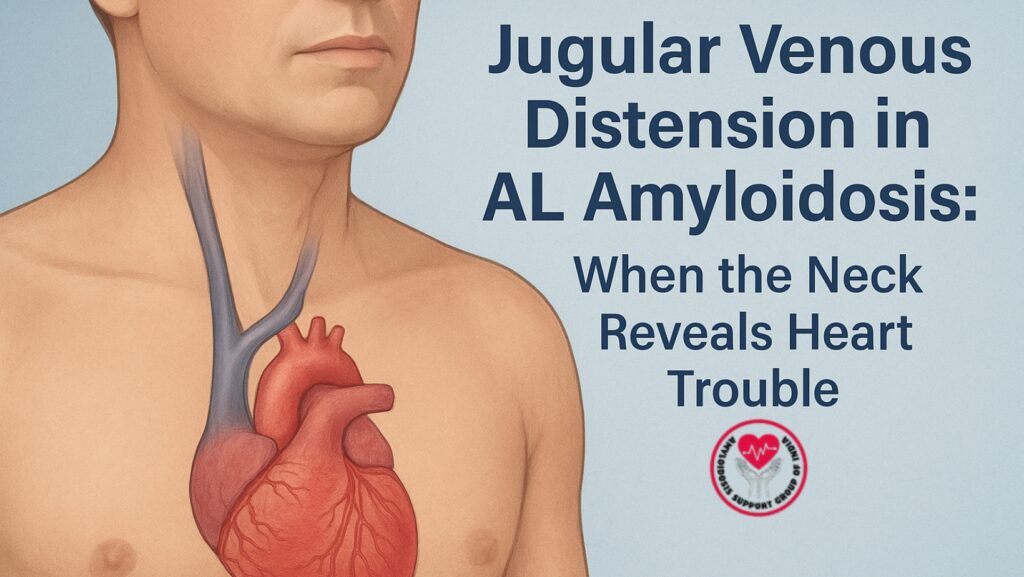
Table of Contents
Introduction
Amyloidosis is a group of rare diseases where misfolded proteins build up in organs and tissues, affecting their structure and function. Among the different types of amyloidosis, AL (Amyloid Light Chain) amyloidosis is the most severe and life-threatening. It begins in the bone marrow, where abnormal plasma cells create excess light chains that form insoluble amyloid fibrils. These fibrils can accumulate in various organs, including the kidneys, liver, nerves, and heart.
Cardiac involvement in AL amyloidosis is a major reason for poor outcomes. The heart gets infiltrated with amyloid proteins, resulting in stiffness and restrictive cardiomyopathy. One of the most obvious clinical signs of this cardiac strain is jugular venous distension (JVD), which is the swelling of neck veins due to increased pressure in the venous system.
This article examines the science, symptoms, diagnostic significance, and treatment of jugular venous distension in patients with AL amyloidosis. It aims to help patients, caregivers, and clinicians understand what JVD indicates, why it happens, and how early detection can be life-saving.
Understanding Jugular Venous Distension (JVD)
The jugular veins are large veins in the neck that carry deoxygenated blood from the head and upper body back to the heart. Normally, these veins are not visibly swollen when a person sits upright. However, when the right side of the heart struggles to efficiently receive or pump blood, pressure builds up in the venous system, causing the jugular veins to become noticeably distended.
Clinically, JVD reflects raised central venous pressure (CVP), an important indicator of right-sided heart function. Doctors often check the jugular veins to estimate CVP and identify early signs of heart failure.
In AL amyloidosis, amyloid infiltration of the heart muscle (cardiac amyloidosis) causes increased stiffness, interrupted filling, and higher right atrial pressures. These changes lead to venous congestion, which appears as JVD. Essentially, JVD serves as the body’s visible signal of hidden cardiac stress.
AL Amyloidosis and the Heart: The Dangerous Connection
In AL amyloidosis, abnormal plasma cells in the bone marrow produce light chains that misfold and clump together into amyloid fibrils. These fibrils enter the bloodstream and infiltrate various organs. When they reach the heart, they accumulate in the myocardium (heart muscle), endocardium (inner lining), and small vessels.
This infiltration results in:
- Thickened and stiff heart walls
- Reduced elasticity and compliance
- Impaired diastolic filling (restrictive physiology)
- Decreased cardiac output
Over time, both sides of the heart deteriorate, but the right ventricle — which receives blood from the body and pumps it to the lungs — is particularly impacted. As the right side fails, blood return is obstructed, leading to increased pressure in the jugular veins. The neck veins then swell visibly, creating the clinical picture of jugular venous distension.
Pathophysiology: How AL Amyloidosis Leads to JVD
The process through which amyloidosis results in jugular venous distension involves several interconnected mechanisms:
- Amyloid Deposition and Stiffness
Amyloid fibrils build up between myocardial fibers, limiting their ability to stretch. This increases ventricular stiffness and raises diastolic pressures. - Increased Right Atrial Pressure
As the right ventricle becomes less compliant, it struggles to accept incoming blood. The pressure then builds up in the right atrium. - Venous Congestion
The higher right atrial pressure extends to the superior vena cava and jugular veins, leading to blood pooling and visible distension. - Loss of Compensatory Mechanisms
Typically, the venous system and right atrium adapt to changes in pressure. In AL amyloidosis, this ability is lost due to infiltration and reduced contractility.
The result is a continuous backlog of blood, leading to a visibly pulsating or swollen jugular vein — a key sign of advanced cardiac amyloidosis.
Why the Neck Veins Reveal Heart Trouble
The jugular veins act as natural pressure gauges for the right side of the heart. When the heart is functioning well, venous pressure remains low and the veins collapse easily when someone sits up. However, if the heart cannot pump blood effectively, venous pressure rises and the veins stay distended.
Because these veins are close to the surface and reflect central venous pressure directly, they provide a non-invasive view of cardiac health. Doctors often use JVD as a bedside sign of right-sided heart failure, pericardial effusion, or restrictive cardiomyopathy, all of which can occur with AL amyloidosis.
In simple terms: when neck veins swell, it’s the heart sending a visible signal that it is under strain.
Clinical Presentation of JVD in AL Amyloidosis
Patients with AL amyloidosis who have heart involvement often show a mix of systemic and cardiac symptoms, such as:
- Shortness of breath (especially when lying flat)
- Swelling of legs, ankles, and abdomen
- Fatigue and decreased exercise tolerance
- Rapid or irregular heartbeat
- Unexplained weight gain due to fluid retention
During a physical examination, jugular venous distension can be noted as:
- Prominent neck veins visible even at a 45-degree angle
- Pulsating veins with each heartbeat
- Engorged veins during inspiration (Kussmaul’s sign)
- A positive hepatojugular reflux — when applying gentle pressure on the liver further distends the neck veins
These findings indicate elevated right-sided pressures and suggest significant impact from cardiac amyloidosis on heart function.
The Hemodynamic Perspective
Hemodynamics — the study of blood flow and pressure — helps explain JVD in depth.
In AL amyloidosis, diastolic dysfunction raises end-diastolic pressure in the ventricles. This increased pressure travels backward to the atria and major veins.
Typical hemodynamic features include:
- Elevated right atrial pressure (≥10 mmHg)
- Equalized diastolic pressures in both ventricles (a hallmark of restrictive physiology)
- Reduced cardiac output
Therefore, JVD in AL amyloidosis indicates right-sided heart congestion and poor forward flow, due to the stiffened, amyloid-laden myocardium.
Diagnosis and Evaluation
Recognizing JVD prompts further testing to evaluate cardiac amyloidosis and how severe it is.
1. Physical Examination
The patient is examined at a 30–45° angle. The clinician measures the vertical height of the jugular vein above the sternal angle. A height greater than 3 cm suggests elevated central venous pressure.
2. Echocardiography
Echocardiography (echo) is often the first imaging test. Findings may include:
- Thickened ventricular walls with a “sparkling” appearance
- Small ventricular cavity size
- Enlarged atria
- Diastolic dysfunction with restrictive filling patterns
3. Cardiac MRI (CMR)
Cardiac MRI provides high-resolution images that can detect amyloid infiltration and characterize tissue using late gadolinium enhancement (LGE). The pattern of diffuse subendocardial enhancement is highly indicative of amyloidosis.
4. ECG Findings
Electrocardiograms often reveal low voltage QRS complexes, conduction blocks, or arrhythmias, which contrast with the thickened ventricular walls seen on echo.
5. Biomarker Testing
Elevated NT-proBNP and cardiac troponins indicate myocardial stress and help determine the stage of cardiac involvement.
6. Tissue Biopsy
A definitive diagnosis comes from biopsy. Tissue samples from abdominal fat, bone marrow, or endomyocardium show amyloid deposits that stain with Congo red and exhibit apple-green birefringence under polarized light.
Differential Diagnosis
JVD can occur in various conditions besides AL amyloidosis, such as:
- Chronic right-sided heart failure (non-amyloid)
- Constrictive pericarditis
- Tricuspid regurgitation
- Pulmonary hypertension
- Superior vena cava obstruction
However, the combination of JVD, thickened ventricular walls with low voltage ECG, and systemic features (like neuropathy, proteinuria, or macroglossia) strongly suggests cardiac amyloidosis.
Management of Jugular Venous Distension in AL Amyloidosis
1. Treating the Underlying Disease
The primary approach is to control amyloid production.
Therapies include:
- Bortezomib-based chemotherapy (CyBorD: Cyclophosphamide, Bortezomib, Dexamethasone)
- Daratumumab-based regimens targeting abnormal plasma cells
- Autologous stem cell transplantation (ASCT) for eligible patients
The aim is to lower light chain production and stop further amyloid buildup.
2. Managing Heart Failure Symptoms
Since amyloid cardiomyopathy is restrictive, standard heart failure treatments need adjustments:
- Diuretics (e.g., furosemide, torsemide) reduce congestion and lower venous pressure, helping alleviate JVD.
- Fluid and salt restriction assist in maintaining volume balance.
- Beta-blockers and ACE inhibitors are used cautiously to avoid hypotension.
- Avoid calcium channel blockers and digoxin, as they may exacerbate symptoms or negatively affect amyloid-affected myocardium.
3. Supportive Measures
- Monitor daily weight and symptoms for early signs of fluid buildup.
- Manage arrhythmias with pacemakers if needed.
- Provide nutritional support for patients with gastrointestinal issues.
- Address anemia and renal impairment that often accompany systemic amyloidosis.
Prognosis and Clinical Outcomes
The presence of JVD indicates advanced right-sided heart involvement. Historically, median survival following the onset of heart failure symptoms in untreated AL amyloidosis was less than 6 months. However, survival has improved with early detection and modern treatments.
Prognosis relies on:
- Degree of cardiac involvement
- Response to chemotherapy
- NT-proBNP and troponin levels
- Functional capacity (NYHA class)
Patients who achieve hematologic and cardiac response can experience longer survival and better quality of life.
The Role of Early Detection
Spotting JVD and other subtle cardiac symptoms early is crucial.
Patients with unexplained swelling, fatigue, or breathlessness — particularly those with kidney or nerve issues — should be screened for amyloidosis. Detecting cardiac involvement promptly allows treatment to start before irreversible heart damage occurs.
Primary care doctors, cardiologists, and hematologists should remain alert when JVD is seen alongside systemic symptoms.
Patient Education and Awareness
Many patients overlook neck vein swelling or think it’s due to general weight gain or fatigue. Public awareness campaigns can help patients understand the significance of this sign. Key educational points include:
- JVD is not normal and often indicates heart strain.
- In AL amyloidosis, it shows serious cardiac involvement.
- Early diagnosis leads to better outcomes.
- Lifelong monitoring is essential, even after remission.
Organizations like Amyloidosis Support India provide information, patient groups, and counseling for those affected by amyloidosis and its cardiac complications.
Research and Future Therapies
Ongoing research aims to enhance early diagnosis and treatment outcomes. Promising areas include:
- Monoclonal antibodies (e.g., CAEL-101, birtamimab) designed to clear existing amyloid deposits
- RNA interference (RNAi) therapies to lower amyloidogenic protein production
- Next-generation proteasome inhibitors with decreased toxicity
- AI-based imaging analysis for early detection of cardiac infiltration
Advances in these fields may prevent issues like JVD by addressing amyloid accumulation at its source.
Conclusion
Jugular venous distension is more than a visible neck symptom — it is a vital diagnostic hint that reveals the hidden struggles in the heart of a patient with AL amyloidosis. When the right ventricle fails because of amyloid infiltration, venous blood cannot return effectively, causing the veins in the neck to bulge.
Recognizing this simple yet significant sign can make the difference between early intervention and lasting cardiac failure. For patients, understanding what JVD means encourages timely consultation and treatment. For clinicians, it serves as a reminder that sometimes the neck can reveal what the heart is silently enduring.
By raising awareness, enabling prompt diagnosis, and applying advanced therapies, the medical community can improve outcomes for patients with cardiac AL amyloidosis — turning this once-silent killer into a condition that can be recognized, treated, and managed with hope.